A hernia is an abnormal protrusion of an organ through a weakness in the abdominal wall. Understanding the different types and treatments is key to effective management.
What is an Inguinal Hernia?
The abdominal muscles are usually strong enough to keep your internal organs in place. When a weakness develops, they may protrude through the musculature, leading to a hernia.
An inguinal (pronounced "ing-win-al") hernia is the most common type of hernia. It usually occurs when fatty tissue or a part of your bowel, such as the small or large intestine, protrudes through the inguinal canal into your groin at the top of your inner thigh.
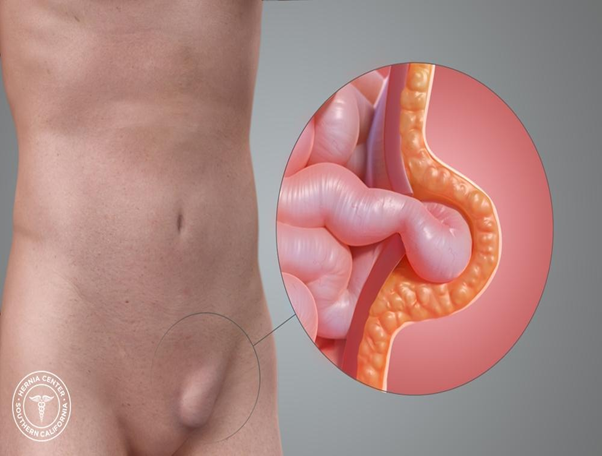
Inguinal Hernia Anatomy
The Inguinal Canal
The inguinal canal is a potential passage that allows for the passage of the testicles in men to descend into the scrotum during development, taking with them blood vessels and the spermatic cord. In women, a remnant persists as the round ligament.
How is it Diagnosed?
The diagnosis is made by your doctor on clinical examination when you present with symptoms such as:
- Swelling in the groin
- Discomfort or pain
Rarely, in difficult cases, the surgeon may require investigation like a Herniogram x-ray, ultrasound scan, or a CT Scan.
How is Inguinal Hernia Managed?
There are different modalities available for hernia repair. Small-sized hernias not causing any symptoms can be kept under observation. However, if it is a large hernia with symptoms like discomfort, pain, nausea, vomiting, or constipation, then a surgical repair is required provided the patient is fit for surgery.
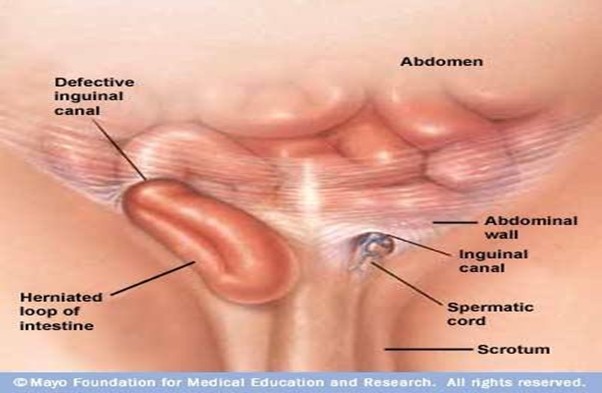
Understanding Hernia Repair
Surgically there are two ways of repairing a hernia:
1. Open Inguinal Hernia Repair
An open inguinal hernia can be repaired through the traditional open technique which requires a 4 to 6-inch incision in the groin region. After reducing the contents of the hernia sack, a prolene mesh is used to strengthen the defect.
2. Laparoscopic Inguinal Hernia Repair
The hernia can also be repaired through laparoscopic technique which requires 3 small cuts in the abdomen. The hernia is repaired along with strengthening of the defect with mesh.
What is the outcome of the operation?
It is usual to experience some pain and discomfort in the post-operative period which gradually subsides. Occasionally there may be a collection of clotted blood or body fluid between the mesh and the skin which usually absorbs spontaneously, though some may require drainage.
One may also experience significant pain after repair which is due to a nerve being trapped in healing scar tissue. You may return to light work as soon as you feel comfortable, usually within 2 weeks in open surgical repair, but lesser in laparoscopic inguinal hernia repair. You should avoid strenuous physical activity or heavy lifting for 4 to 6 weeks.
What happens if you decide not to undergo operation?
Some patients wish to continue with observation until the hernia causes symptoms. However, if you do not undergo surgery for a hernia, one can develop progressive symptoms requiring an operation at a later date.
Risks of Untreated Hernia
The hernia may develop a blockade (Intestinal Obstruction) or develop strangulation (Blood supply to the bowel is cut off) which may require emergency surgery—the outcome under these circumstances may be worse than an elective surgery.